

AI Tokenomics Framework
An enterprise economic control system for AI: governing demand, access, consumption and value. Not a cryptocurrency model.
AI economics are inseparable from AI architecture.
An enterprise economic control system for AI, not a cryptocurrency model.
AI has a different economic profile from traditional enterprise software. Cost can scale with every prompt, completion, image, video, agent loop, tool call, retrieval, GPU second or reserved-capacity decision. A fixed license may sit alongside highly variable consumption. Agentic workloads can multiply calls without a corresponding increase in human users. Model quality and cost vary significantly.
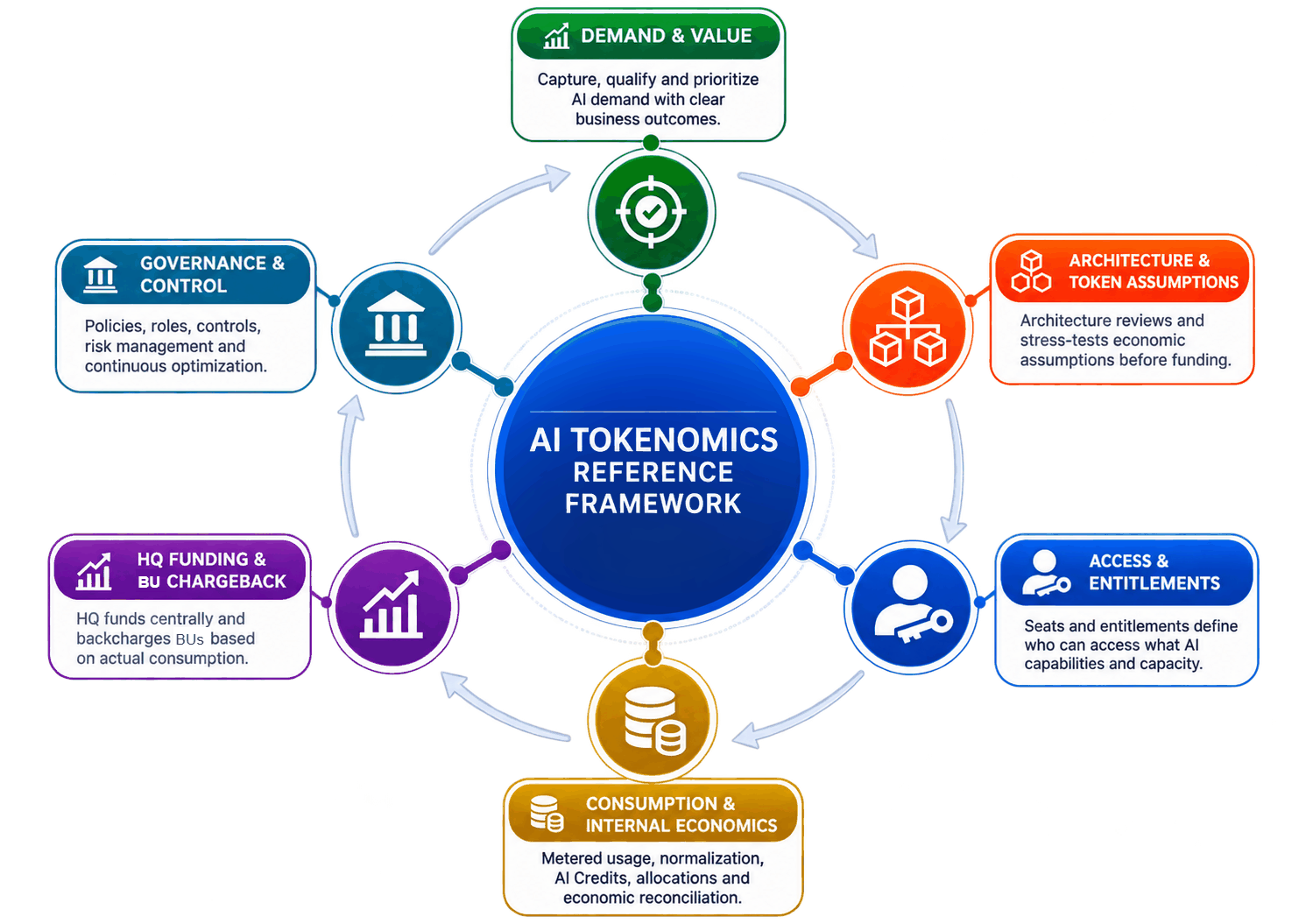
The AI Tokenomics Framework treats these economics as an enterprise control system. Headquarters (HQ) centralizes commercial leverage and payment; Business Units (BUs) generate and sponsor demand; Architecture tests whether proposed designs are economically efficient; the platform meters actual usage; Finance converts usage into transparent chargeback; and governance continually reallocates capacity toward the highest-value demand.
The term “tokenomics” is used in an enterprise sense: how scarce AI capacity and economic rights are allocated, measured, governed and reconciled. The framework does not create a cryptocurrency, and it assumes no blockchain, public tokens, crypto-assets or decentralized governance. It is provider-agnostic and technology-agnostic: it can govern cloud AI services, foundation models, API-based AI, enterprise copilots, agentic solutions, GPU capacity, AI platforms and internally hosted services.
HQ funds AI centrally. AI Credits allocate economic capacity. Seats and Entitlements control access. Capacity commits supply. Business Units are backcharged on transparent, auditable consumption.
The framework is currency-agnostic. AED is used as the illustrative reference currency throughout; substitute the reporting currency of your own group.
HQ funds
Central contracting and payment for approved AI providers, consolidated into one enterprise AI cost pool.
Credits allocate
One stable internal unit normalizes heterogeneous provider billing units for planning and control.
Entitlements control
Seats and entitlements determine who, or what, may consume which AI capability.
Capacity commits
Committed, reserved and on-demand supply, with its economic exposure owned before purchase.
BUs are charged
Transparent, auditable backcharge on actual consumption plus governed allocation of committed and shared cost.
Architecture is tested
Every material use case passes an architecture review and a Token Assumption Stress-Test before funding and again before release.
Scroll the diagram sideways, or open it full size.
Foundation and economic model
The enterprise philosophy, twelve design principles and the three operating objects: AI Credits, Seats and Entitlements, and Capacity.
Framework definition
AI Tokenomics is the design and operation of the economic rules through which AI demand is prioritized, AI capacity is purchased, access is granted, consumption is measured, costs are allocated, Business Units are backcharged and enterprise value is realized.
It is both a financial-control model and an architecture-control model, because the technical design of an AI solution directly determines how quickly economic capacity is consumed. The largest cost decisions in AI are usually made by the architect, not by the buyer.
Key rule: five questions before funding
Every material AI use case must be able to answer five questions before it is funded.
What value will it create?
What architecture will deliver that value?
What AI consumption will the architecture generate?
Who funds and owns that consumption?
What evidence will prove the value after release?
Design principles
Twelve principles govern every design decision in the framework. When two mechanisms conflict, the principle wins.
Value first
AI Credits are not an objective. They are a means of allocating scarce AI economic capacity to the outcomes with the strongest strategic and operational value.
Central funding, distributed accountability
HQ secures enterprise commercial leverage and pays centrally. BUs remain accountable for justified demand, consumption behavior and benefit realization.
Stable internal unit
BUs plan and manage in stable AI Credits and currency-equivalent economics rather than provider-specific billing units.
Architecture and economics are co-designed
Model choice, agent patterns, context size, RAG design, caching and concurrency are economic design decisions and must be reviewed as such.
Meter everything material
Every billable event must be attributable to a business unit or function, use case or application, project or workload, user or agent, and model or SKU wherever technically feasible.
One primary charging basis per component
Do not double-charge the same underlying compute as model tokens, GPU seconds and requests unless they represent distinct service components.
Actual consumption before blunt allocation
Use direct attribution where data exists. Allocate shared costs only where direct attribution is not possible or would create disproportionate operational complexity.
Committed capacity has an owner
Unused committed or reserved capacity is still an economic cost. Ownership of that cost must be explicit before purchase.
Assumptions are temporary
Forecasts are hypotheses. Architecture and token assumptions are revalidated with pilots, pre-production tests and production telemetry.
Optimize continuously
Model routing, caching, prompt compression, RAG tuning, capacity reservations, quotas and provider mix are adjusted within governed bounds as evidence improves.
Fair, transparent and reproducible
A BU should be able to reconstruct why it was charged, which use cases generated the charge and which allocation rules were applied.
Secure and compliant by design
Cost optimization must never bypass cybersecurity, privacy, data residency, architecture, model-risk or operational-resilience controls.
The three operating objects
The framework deliberately separates the unit of economic allocation from the right to access a service and from the underlying supply commitment. This avoids the common enterprise mistake of treating a “seat”, a “token” and a “budget” as interchangeable concepts.
AI Credit
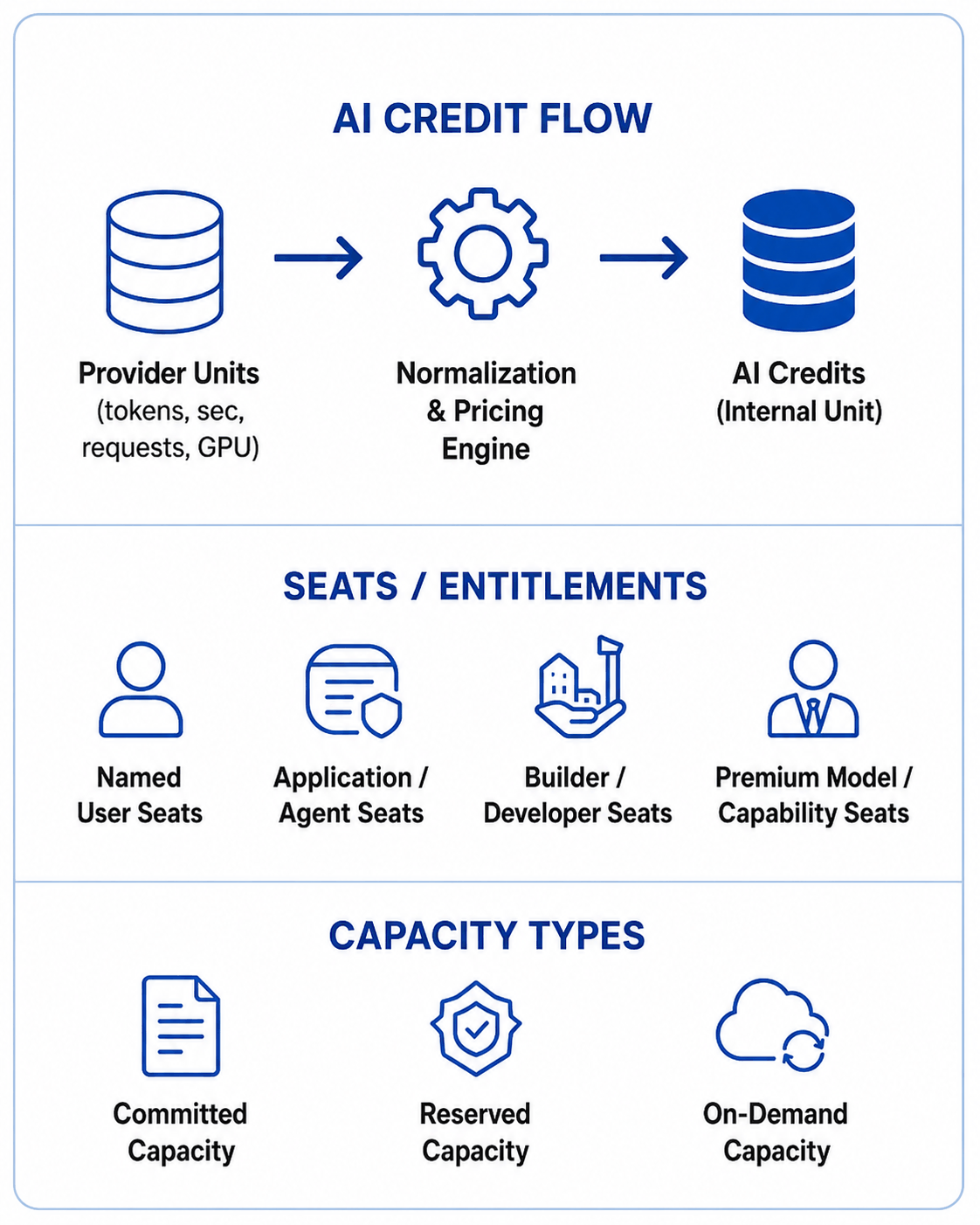
How much economic capacity is allocated and consumed. A stable, non-transferable internal accounting unit that normalizes provider units into one economic language.
Seat / Entitlement
Who or what may consume which AI capability. Applies to named users, applications, agents, builders, premium models and controlled environments.
Capacity
What supply HQ has purchased or reserved. Committed, reserved, on-demand, burst and fallback supply. Creates exposure before any consumption occurs.
Scroll the diagram sideways, or open it full size.
AI Credits
An AI Credit is a stable, non-transferable internal accounting unit created for planning and control, not as a financial asset. It converts heterogeneous provider billing units (input and output tokens, requests, GPU seconds, image generations, reserved throughput) into a common economic language, so a BU can compare an LLM workload, an image-generation workload and a GPU-intensive workload without managing several provider-specific billing systems.
Recommended reference design: one AI Credit initially represents AED 1 of normalized AI economic cost. The Credit is not currency relabelled. Rate-card churn, repricing and FX movement are absorbed through the governed conversion factor, keeping BU plans stable between resets, and allocation priority, quotas and capacity rights are expressed in Credits, functions that currency alone does not perform.
AI Credits do not create spending authority by themselves. A credit allocation is the economic envelope within which approved use cases may consume AI. The financial charge is produced through reconciliation against metered usage, rate cards, provider invoices and agreed shared-cost rules.
Recommended starting unit: 1 AI Credit = AED 1 of normalized AI economic cost. A starting convention, not an immutable rule. Conversion factor, repricing cadence and absorption rules are approved by Finance in the Parameter Registry.
Seats and Entitlements
Seats and Entitlements define who or what may access AI capabilities. A named user seat may unlock a cowork or copilot service; an application entitlement may permit a production system to call approved models; an agent entitlement may allow autonomous execution within a defined quota; a builder entitlement may permit development tools or premium models. Entitlements govern access; they do not replace consumption budgets.
Named user seats
Assigned to individual users for defined services or feature tiers.
Application or agent seats
Assigned to non-human identities, APIs, services or autonomous agents.
Builder / developer seats
Access to development environments, model catalogs, evaluation tools and higher experimentation quotas.
Premium model entitlements
Authorize access to high-cost or restricted models for approved use cases.
Capacity entitlements
Reserve scarce throughput or GPU capacity for a defined workload, project or BU.
Capacity
Capacity is the supply side of the framework. HQ may buy committed capacity for a period, reserve throughput for critical workloads or use on-demand services. These decisions have different economic consequences. On-demand maximizes flexibility but may carry higher unit cost. Reserved capacity can reduce unit cost and protect performance but creates idle-capacity risk. Committed enterprise capacity can improve commercial leverage but shifts the cost of under-utilization onto the Group.
Economic flow
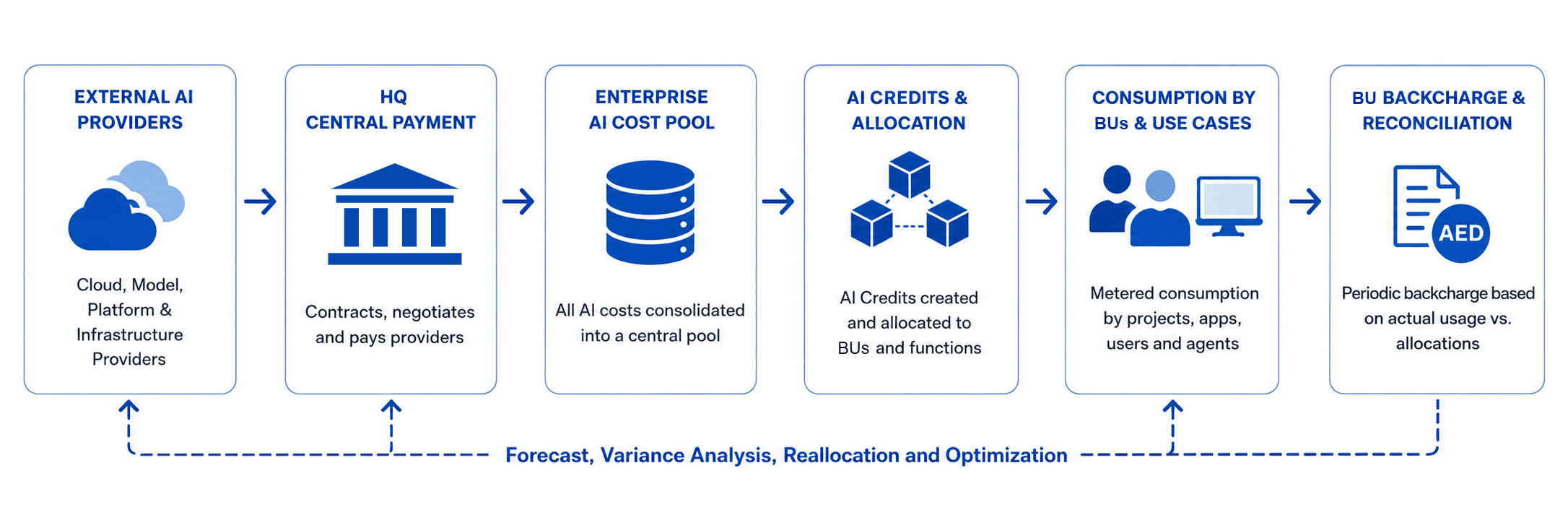
HQ is the central commercial anchor. Approved provider invoices, subscription costs, committed-capacity charges and platform costs are consolidated into an enterprise AI cost pool. The cost pool is mapped to rate cards and AI Credits, allocated to approved demand, and then reconciled back to BUs based on actual use and the agreed treatment of committed and shared costs.
The feedback loop matters as much as the forward flow. Forecasts are compared with actual consumption; large variances trigger analysis; unused capacity is reallocated where possible; and architecture, rate cards, quotas or provider commitments are changed when the evidence supports it.
Scroll the diagram sideways, or open it full size.
Demand to execution
Connecting business demand to architecture, consumption economics, funding and release through explicit lifecycle gates.
Demand-to-execution lifecycle
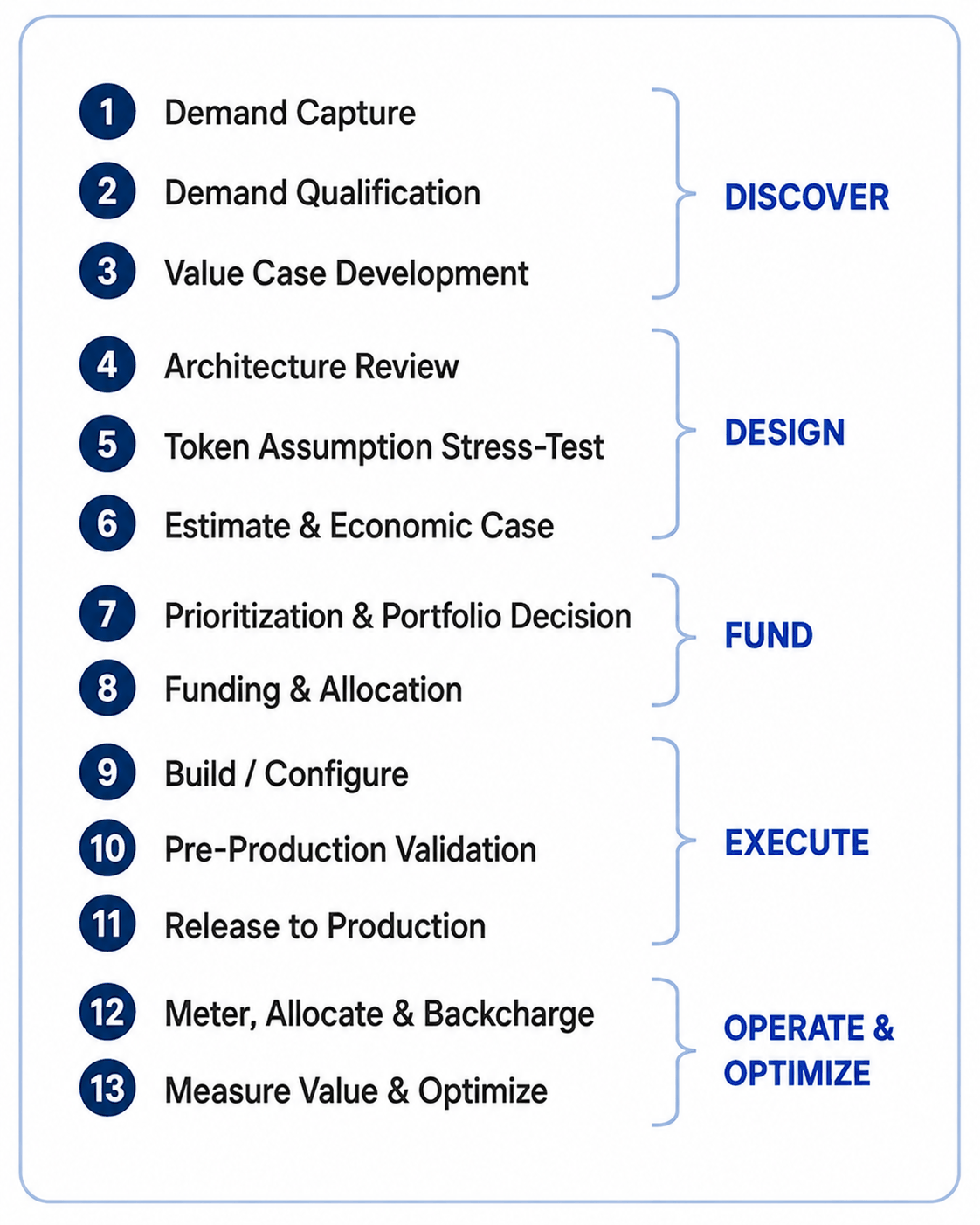
The lifecycle is the backbone of the framework. It prevents AI economics from becoming a post-deployment billing exercise. Consumption assumptions are created while the solution is still being designed, challenged before funding, validated before production and continuously reconciled after release.
Demand capture
A BU or HQ function records the problem, sponsor, business outcome, affected users and processes, criticality, initial demand pattern and expected timing. Demand is expressed as an outcome, not as a preferred model or vendor.
Demand qualification
The demand is screened for strategic alignment, duplication, feasibility, data readiness, security implications, sponsorship and whether an existing service can meet the need.
Value case development
The sponsor defines measurable outcomes, baseline performance, target improvement, expected adoption and post-release value measures. Benefits may be financial, productivity, risk, safety, reliability, quality or strategic enablement.
Architecture review
Architecture identifies the solution pattern, model family, data flows, RAG design, integration approach, agent and tool pattern, hosting model, resilience and control requirements. Alternatives are considered before cost assumptions are locked.
Token Assumption Stress-Test
The proposed design is translated into consumption drivers: input and output tokens, context length, tool calls, retrieval volumes, agent loops, retries, concurrency, GPU usage, model tier and growth, across minimum, base and maximum scenarios.
Estimate and economic case
Architecture scenarios are converted into AI Credits, currency-equivalent cost, required seats, capacity requirements, shared cost assumptions and expected cost per business outcome or transaction.
Prioritization and portfolio decision
HQ and BU decision-makers compare business value, risk, strategic importance, economic demand and capacity constraints. Demand can be approved, deferred, rejected, merged or returned for redesign.
Funding and allocation
HQ approves the funding envelope, AI Credit allocation, seat and entitlement profile, capacity commitment, chargeback owner and exception rules. The allocation is recorded before build begins.
Build or configure
The solution is implemented within approved architecture and economic guardrails. Metering tags and chargeback identifiers are embedded as part of the technical design, not added after release.
Pre-production validation
Load tests, pilot data and final architecture are compared with the original token assumptions. Material variance requires re-estimation, redesign or a revised funding decision.
Release to production
Release is authorized only when architecture, security, operational readiness, cost guardrails, metering and ownership are in place.
Meter, allocate and backcharge
Production events are measured, normalized into AI Credits, attributed to the agreed hierarchy and reconciled to BUs. Quotas and alerts provide in-period control rather than waiting for month-end invoices.
Measure value and optimize
Actual business outcomes are compared with actual consumption. Low-value consumption is reduced or retired; successful demand can receive more capacity; and architecture assumptions are recalibrated for future use cases.
Scroll the diagram sideways, or open it full size.
Lifecycle gates and materiality
The lifecycle uses four decision gates rather than a single project-approval event. Each gate answers a different question and has different evidence requirements.
| Gate | Core decision | Minimum evidence |
|---|---|---|
| G1: Qualify | Should the Group invest analysis effort? | Sponsor, problem, strategic alignment, non-duplication, initial feasibility. |
| G2: Design & Economics | Is the proposed architecture economically credible? | Architecture review, token stress-test, minimum/base/maximum consumption, risk and alternatives. |
| G3: Fund | Should HQ allocate AI Credits, seats and capacity? | Value case, BU owner, cost estimate, funding source, chargeback treatment, portfolio priority. |
| G4: Release | Do actual design and tests still fit the approved assumptions? | Final architecture, security approval, metering, pre-production consumption test, production guardrails. |
Materiality tiers and the fast-track lane
Every lifecycle gate applies to material demand, but materiality cannot remain a judgment call. Without a numeric definition, either all demand queues for full review or teams self-classify around the gates. Materiality is therefore a governed parameter with explicit tiers, and gate effort scales with economic exposure.
Material
Forecast above 100,000 Credits per year, any agentic workload or premium-model dependency. Full G1–G4 gating with the Token Assumption Stress-Test.
Standard
10,000–100,000 Credits, with a lightweight stress-test and delegated approval.
Fast-track
Below 10,000 Credits on approved patterns and models. Catalog-based self-service within the BU envelope, with sampled retrospective review. A use case that outgrows its tier is re-classified and re-gated.
Tier thresholds are Parameter Registry defaults: Tier 1 above 100k Credits a year, fast-track below 10k, re-tiering at +20% sustained.
Architecture review and the Token Assumption Stress-Test
The Architecture Review is the point at which the framework challenges the idea that AI consumption is merely a Finance problem. The largest cost changes often originate in technical design: selecting a premium model where a smaller model would suffice, retaining excessive context, allowing uncontrolled agent loops, using high retrieval counts, failing to cache stable results, or provisioning capacity for peak demand that rarely occurs.
Workload characterization
Architecture begins by describing the workload in economic terms: the user or machine population, expected interactions, transaction pattern, peak-to-average ratio, latency target, prompt and response profile, RAG behavior, tool integrations, model modality, data movement, regulatory constraints and availability requirement. The objective is to understand what causes consumption before selecting a commercial plan or capacity commitment.
Assumptions to stress-test
- Model choice and model routing: premium versus smaller model, fallback and specialist models
- Input-token volume, output-token volume and retained context length per interaction
- Agent loops, planning calls, tool calls, retries, validation calls and failure recovery
- Concurrency, peak load, batch size, queueing and latency requirements
- Caching, prompt compression, context distillation and semantic-reuse assumptions
- RAG retrieval count, chunk size, reranking, embedding frequency and document refresh patterns
- GPU seconds, image and video generation duration and accelerator class where applicable
- Data movement, network egress, vector storage, logging and observability overhead
- Expected adoption curve, seasonality, growth, burst events and exceptional operating periods
- Provider unit-cost volatility, rate-card changes, currency effects and minimum commitments
- High-availability, disaster-recovery and multi-provider fallback patterns
- Operating controls such as safety checks, evaluation, content filtering and audit logging that themselves create additional calls
Required scenario outputs
The stress-test produces three consumption envelopes: minimum, base and maximum. A single-point estimate creates false precision and makes approval brittle. Each scenario should show AI Credits per transaction or user, monthly AI Credits, currency-equivalent cost, required seats, peak throughput, required reserved capacity, cost per business outcome and the variables that create the largest sensitivity.
Architecture acceptance rule: a material use case should not be funded with a high-confidence single number when its economics are dominated by untested architecture assumptions. Where uncertainty remains high, the correct response is a bounded pilot with explicit measurement objectives.
Scroll the diagram sideways, or open it full size.
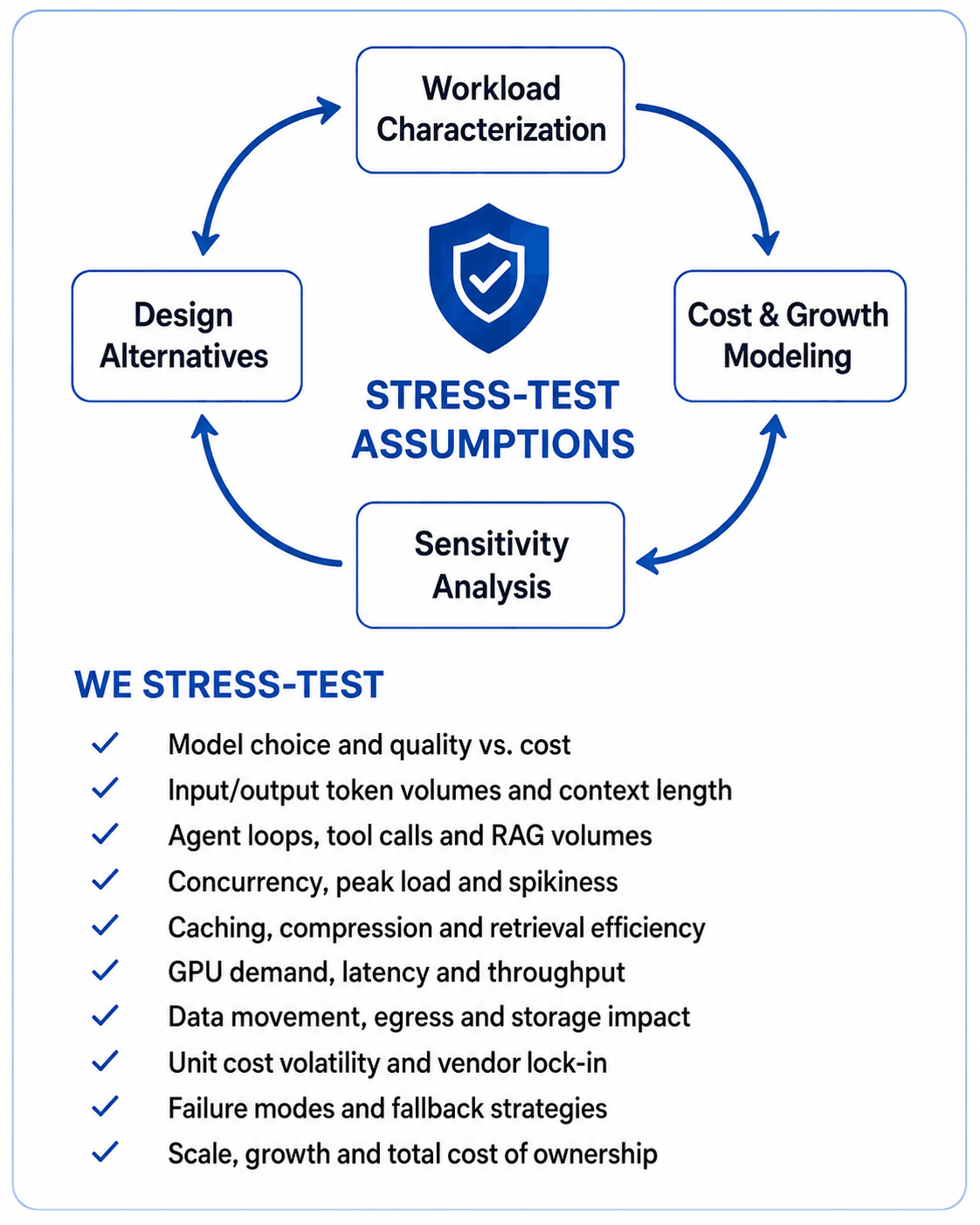
Sensitivity and breakpoint analysis
The review identifies the points at which an apparently attractive design changes economic character: the user count at which reserved capacity becomes cheaper than on-demand; the context size at which a premium model becomes the dominant cost driver; the concurrency level at which a different architecture is required; or the agent-loop count at which automation no longer produces an acceptable cost per outcome.
The most important output is not a cheaper estimate. It is a better decision. A more expensive architecture may be justified if it materially improves safety, reliability or business value. The framework requires that the trade-off be explicit.
Pre-production economic validation
The Token Assumption Stress-Test is repeated immediately before production, using the actual configured model, prompts, RAG corpus, tools, concurrency controls and test traffic. The predicted range is compared with observed consumption. A large variance is treated as a design exception, not as a normal surprise to be absorbed by the BU after go-live.
- Recalculate tokens, requests and GPU usage from test telemetry rather than design estimates.
- Confirm committed or reserved capacity assumptions against measured peak demand.
- Confirm attribution tags and cost-center mapping can be reconstructed end-to-end.
- Update the BU funding envelope where the approved estimate no longer represents the production design.
- Validate budgets, hard limits, throttles, concurrency and emergency stop behavior.
- Record the final baseline in the Parameter Registry and use it for post-release variance monitoring.
Quality gating and evaluation
Economic optimization without measured quality degrades outcomes invisibly. A cheaper model, shorter context or reduced retrieval count is only an optimization if the task still succeeds. Every material use case therefore defines task-level evaluations before funding, not after go-live.
The evaluation set and quality threshold are recorded at Gate G2 alongside the token assumptions. Any routing, prompt, context or model change that reduces Credits is approved only if evaluation scores remain within the approved tolerance. In production, sampled evaluations run continuously. A quality regression is treated with the same severity as a budget variance: investigated, attributed and corrected. The governing metric is cost per successful outcome, not cost per call.
Acceptance rule: cheaper is only cheaper if quality holds. Evaluation sets, thresholds and sampling rates are governed parameters, owned by the use-case owner and Architecture, reviewed at rate-card cadence.
Prioritization and funding logic
AI Credits should not be allocated solely by historical spend or on a first-come, first-served basis. Portfolio allocation considers business value, strategic alignment, regulatory or safety need, time criticality, architecture confidence, expected consumption, reuse potential and scarcity of capacity. A low-cost use case is not automatically high value, and a high-cost use case is not automatically inefficient.
The funding decision must record the BU that owns the economic outcome, HQ or Group-level sponsorship where applicable, the credit envelope, seat profile, capacity commitment, chargeback rule and the date at which the allocation will be reviewed. Strategic enterprise capabilities can be centrally sponsored for a defined period, but the subsidy must be visible rather than hidden inside provider invoices.
Records the BU that owns the economic outcome
Fixes the credit envelope, seat profile and capacity commitment
States the chargeback rule and review date
Makes any central subsidy visible, never hidden
Reuse and producer incentives
Prioritization rewards reuse potential, but the BU that builds a reusable asset (a RAG corpus, an evaluation set, a fine-tuned model) carries its full cost while others consume it free. Left uncorrected, the framework under-produces shared assets.
Reusable assets are registered in the enterprise catalog with a named producer. When a registered asset is consumed by another BU, a governed share of the consuming charge flows back as producer credits against the producer’s envelope. Producer credits appear in showback as a separate line, are capped as a share of the producing use case’s cost, and expire with the asset’s certification. An asset must pass quality gating before it earns credits.
Design rule: reuse is rewarded, not just requested. Producer-credit rate, cap and asset certification rules are governed parameters in the Parameter Registry, reviewed quarterly by Finance.
Access, consumption and chargeback
How HQ purchases AI, how access is granted, how consumption is normalized and how costs are transparently reconciled back to Business Units.
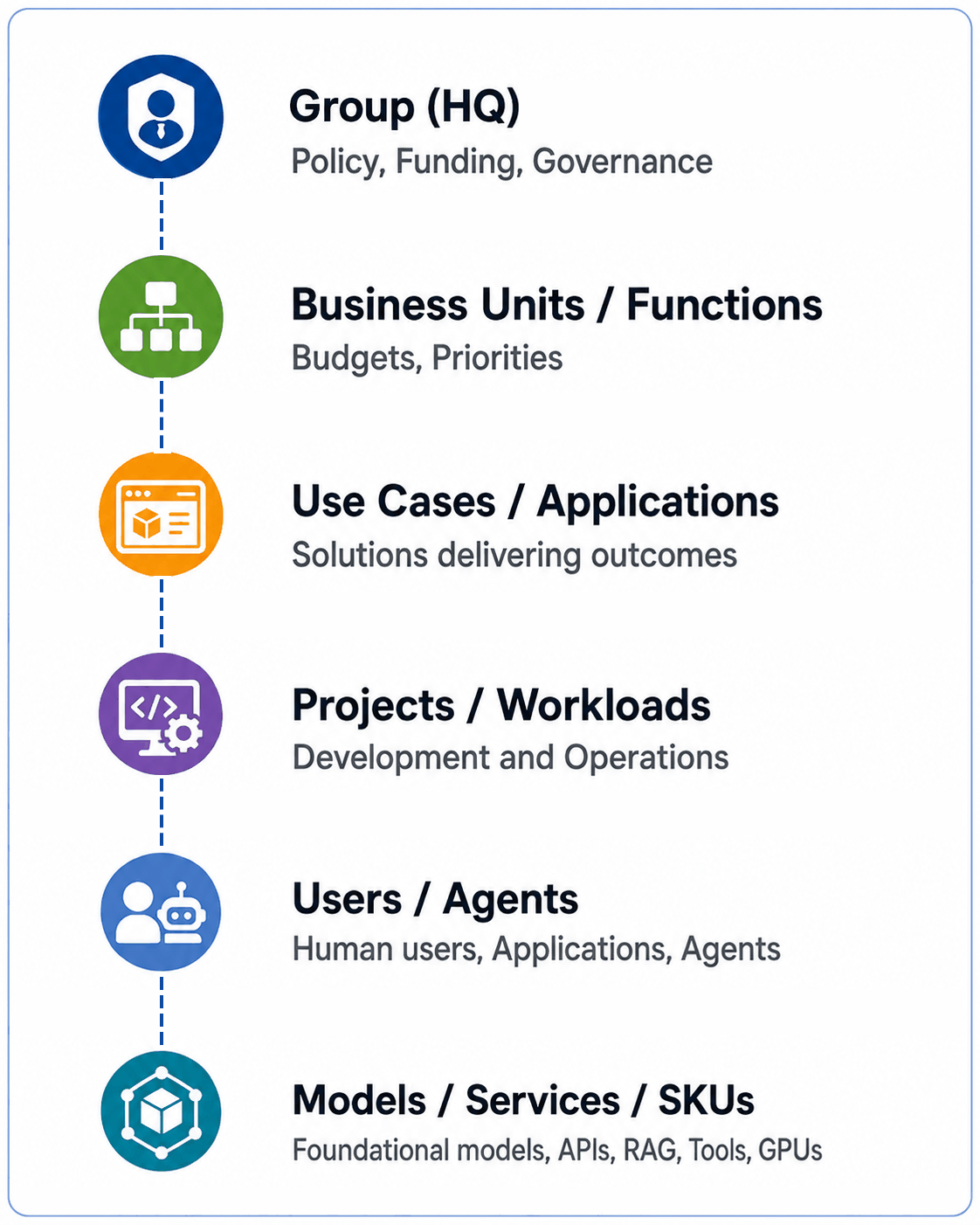
Enterprise consumption hierarchy
Every consumption event should be attributable through a standard hierarchy. It allows HQ to aggregate enterprise demand while giving BUs enough detail to manage their own portfolios, and prevents chargeback from stopping at a total that business owners cannot explain.
Group / HQ
Enterprise policy, provider strategy, funding rules and economic guardrails.
Business Unit or Function
Demand portfolio, allocation envelope, operational budget, priorities, budget accountability, domain ownership and value realization.
Use case or Application
Approved business capability that consumes AI.
Project or Workload
Implementation scope, environment or bounded work package.
User or Agent
Human or machine actor generating consumption.
Model / Service / SKU
The billable technical service that produced the provider cost.
Not every provider can expose all of these dimensions natively. Where direct tagging is unavailable, the platform must create an internal mapping through API keys, service principals, gateway metadata, workspace IDs or cost-allocation tags.
Scroll the diagram sideways, or open it full size.
AI Credit design
The AI Credit is the common internal economic language. It normalizes provider-specific units without hiding the technical meter. The platform must retain both views: raw usage for engineering optimization and AI Credits for financial control. A BU should be able to see that a workload consumed 3.2 million input tokens and 0.6 million output tokens while Finance sees the normalized credit value and currency-equivalent charge.
Provider usage priced using the effective enterprise rate card.
Cost converted to the reporting currency using the approved Finance exchange-rate rule.
Normalized cost expressed as AI Credits.
Shared and committed cost allocated separately from direct variable cost.
Credit types
For reporting, the framework distinguishes several logical credit categories even though they share one unit of account. These categories are reporting labels, not separate currencies. The separation makes the economics explainable and allows leadership to see whether BU consumption is rising because of business demand, capacity commitments or centrally funded enablement.
Direct Consumption Credits
Represent variable provider usage.
Committed Capacity Credits
Represent the economic share of capacity purchased in advance.
Shared Platform Credits
Represent common platform services that cannot be directly attributed.
Strategic Subsidy Credits
Represent temporary HQ-funded consumption that is intentionally not backcharged in full.
Model-cost deflation and windfall treatment
AI unit costs fall predictably as providers reprice and more efficient models ship. The framework defines in advance who captures this windfall, so a provider price drop never becomes an invisible margin inside the enterprise cost pool.
Provider reductions flow into the enterprise rate card at the scheduled reset. Between resets, the spread between the governed rate and the effective provider price is captured centrally and reported as a visible efficiency line, never silently absorbed. At each reset the windfall passes through to BUs in full by default. HQ may retain an approved share to fund the Experimentation Tier or enterprise enablement, but only as an explicit, sponsored line.
Default treatment: full pass-through at reset; visible spread in between. Repricing cadence (default: quarterly rate-card reset with monthly review), windfall split and any HQ retention are Finance-approved parameters in the Parameter Registry.
Credit expiry, carry-forward and anti-hoarding
Credit expiry rules shape behavior at period boundaries. Hard expiry drives use-it-or-lose-it dumping in the final month; unlimited carry-forward drives hoarding and disconnects allocations from real demand. Both distortions are designed out explicitly.
Default rule: allocations are quarterly envelopes. Unused Credits carry forward up to 20% of the quarterly envelope and expire at financial year-end. Released balances return to the enterprise pool for reallocation to funded demand. Credits remain non-transferable between BUs. Reallocation happens only through the governed quarter-end process, and consumption spikes in the final month of a period are flagged for review as potential dumping.
Design rule: no dumping, no hoarding; expiry is engineered. Carry-forward cap, expiry horizon and period-end spike thresholds are governed parameters in the Parameter Registry, approved by Finance and reviewed annually.
Adverse rate movements
Windfall treatment governs falling provider prices; rising prices need the same discipline. Without a stated rule, an in-period provider increase becomes an invisible loss inside the enterprise cost pool, the mirror image of a hidden margin.
Between rate-card resets, adverse spread is absorbed centrally and reported as a visible exposure line, keeping BU plans stable. It is never silently rebilled mid-period. An increase above threshold triggers an early rate-card reset with notice to affected BUs, plus an architecture review of routing alternatives before the new rate is passed through.
Design rule: price rises are governed like windfalls, symmetrically. The adverse-spread threshold (default: +10% sustained for one month), early-reset trigger and notice period are Finance-approved parameters in the Parameter Registry.
Seat, entitlement and capacity management
Seat and entitlement management
Seat allocation is a demand-control mechanism. Named-user subscriptions, premium model access and builder environments can create cost before usage begins. The entitlement process therefore links each seat to an owner, purpose, BU, term, review date and associated credit budget. Seats should be reclaimed when inactive, transferred when organizational responsibility changes, and periodically recertified.
Application and agent entitlements require the same discipline as human seats. An autonomous agent with a high concurrency limit can create substantially more cost than a single user and should not inherit a user-like entitlement by default.
Capacity management
HQ should manage capacity as a portfolio rather than as isolated technical reservations. Each commitment should state the workloads it protects, the expected utilization, the economic owner of under-utilization, the duration and the conditions under which capacity may be reallocated to another BU.
Committed
Purchased for a contract period and economically due regardless of actual use.
Reserved
Dedicated or prioritized throughput for defined workloads, often with minimum duration or fixed cost.
On-demand
Paid when consumed, therefore more flexible but potentially more expensive or less predictable.
Burst
Short-term additional supply for peak events, testing or exceptional demand.
Fallback
Secondary model or provider capacity retained for resilience and operational continuity.
A core governance metric is utilization of committed capacity. Persistent under-utilization is not a metering problem; it is a portfolio and commercial decision problem. Persistent over-utilization is similarly a signal that quotas, architecture or commercial commitments need to change.
Self-hosted and GPU capacity economics
Data residency, sovereignty and cost will drive some workloads onto self-hosted GPUs and sovereign platforms. Owned infrastructure must enter the Credit model on equal terms with provider APIs, or make-versus-buy decisions become distorted.
Owned capacity carries an internal rate card: hardware amortized over useful life, plus power, facilities, licenses and operations, expressed per GPU-hour or per token where meterable. The rate is versioned and effective-dated like any provider rate card. Utilization risk is owned like committed capacity: an under-used cluster has a named economic owner. Make-versus-buy comparisons use the fully loaded internal rate against API pricing at equivalent quality, never bare hardware cost.
Design rule: owned GPUs are a rate card, not free capacity. Rate methodology, amortization life and the accelerator utilization target (default 65%) are reviewed quarterly by Finance and the platform owner.
Central funding and BU chargeback
HQ central funding model
HQ should act as the single economic consolidator for enterprise AI wherever this produces better leverage, standardization and control. The central model allows the Group to negotiate enterprise rates, manage commitment risk across BUs, reduce duplication, standardize controls and move unused capacity between demand pools.
The enterprise AI cost pool should distinguish costs that behave differently. Treating all four as one blended cost would make optimization harder and chargeback less fair.
Directly attributable
Variable model and API consumption.
Portfolio decision
Committed or reserved capacity.
Seat-based
Named-user licenses.
Enterprise overhead
Shared orchestration, security, observability and platform tooling.
BU chargeback model
Chargeback converts the central funding model into distributed accountability. It is not intended to recreate provider invoices line by line. The objective is to allocate economic responsibility using a rule that is accurate enough to influence behavior, simple enough to understand, stable enough to budget and detailed enough to audit.
Every allocation rule is published and versioned. BUs receive in-period showback before final chargeback so they can act before month-end or quarter-end. The default allocation sequence: direct cost first, then dedicated commitment, then shared commitment, then shared platform cost, then any approved strategic subsidy or adjustment.
| Cost layer | How it is charged |
|---|---|
| Direct variable consumption | Where usage can be directly attributed to a BU or use case, the resulting AI Credits are charged directly: model tokens, inference calls, GPU seconds, image and video generation and other provider units for which the gateway or platform can identify the consuming workload. |
| Dedicated capacity | Capacity dedicated to a single BU or use case is charged to that owner, including unused portions, unless the commitment was explicitly sponsored as an enterprise strategic reserve. This creates the correct incentive for the demand owner to right-size the commitment. |
| Shared capacity | Allocated using the economic driver that caused the capacity to be purchased. Actual consumption suits a common pool; peak-demand contribution is more appropriate when one BU creates the peak that determines the commitment. |
| Shared platform cost | Common platform services can be retained centrally, allocated by consumption or distributed through another approved driver. Costs that scale with usage should progressively move toward consumption-based allocation. |
| Strategic subsidy | HQ may temporarily subsidize emerging capabilities, pilots or strategic programs. The subsidy must be explicit: a separate reporting line with a sponsor, amount, purpose and expiry or review date. |
The Experimentation Tier
Chargeback disciplines consumption, but its documented side effect is that it suppresses experimentation: teams stop trying new AI capabilities because every token now carries a visible price. Left untreated, the framework’s success at cost control becomes its failure at innovation.
The Experimentation Tier is the designed countermeasure. Each BU receives a capped, centrally subsidized allowance of Experimentation Credits each quarter, usable only in non-production environments, exempt from chargeback, and expiring automatically at quarter-end. Unused allowance does not roll over and cannot be transferred.
Experiments that demonstrate value graduate into funded pilots through the standard Token Assumption Stress-Test and funding gates. All experimentation usage remains fully metered and visible in showback, so the subsidy is transparent, never invisible.
Design rule: capped, subsidized, auto-expiring; never a backdoor budget. Cap size, eligible environments and expiry cadence are governed parameters in the Parameter Registry, approved by Finance and reviewed quarterly.
Cadence, budgets, quotas and pricing levers
Showback, chargeback and true-up cadence
The framework recommends near-real-time or daily showback for operational management, monthly chargeback for recurring variable usage and quarterly true-up for commitments, allocation corrections and strategic subsidies. Finance may select a different accounting cadence, but operational visibility should be materially faster than the financial posting cycle.
Consumption, budget, quota, unusual spikes and premium-model usage, at near-real-time or daily granularity.
BU and use-case actual credits, currency-equivalent cost, direct variable charge, seat cost and allocated shared cost.
Committed-capacity utilization, forecast accuracy, allocation true-up, vendor commitment review and subsidy review.
Provider portfolio, commercial terms, commitment level, rate-card design and enterprise demand forecast.
Budgets, quotas, rate limits and concurrency
Financial budgets and technical limits serve different purposes and should not be collapsed into one setting. A use case may be within budget but still require a rate limit to protect service quality and avoid burst cost. A budget caps economic exposure. A quota allocates consumption over a period. A rate limit controls short-period throughput. A concurrency limit controls the number of simultaneous expensive operations.
Recommended nesting follows the consumption hierarchy: Enterprise → Business Unit or Function → Use Case or Application → Project or Workload → User or Agent → Model or SKU. Lower-level limits must not circumvent a higher-level hard cap. Exceptions are time-bound and logged.
Pricing levers and demand shaping
Quotas and governance forums ration demand in discrete steps; prices shape it continuously. A tokenomics framework that relies only on quotas forces every trade-off through a committee. Internal price signals let users feel the cost gradient in-period and self-optimize without escalation.
Peak / off-peak rates on constrained capacity.
Premium-model markups on frontier models.
Congestion pricing when pools run above target utilization.
Batch discounts for latency-tolerant work.
Fill discounts on idle committed capacity below target, so paid-for throughput is used, not wasted.
Every lever launches at a neutral setting, so day-one behavior is unchanged. Activation, rate levels and review cadence are decided by the economic governance forum with Finance approval, and each activation’s effect is measured through variance decomposition before it is retained.
Operating principle: prices shape demand; quotas cap it. All levers are recorded in the Parameter Registry at neutral settings. Activating one is a governed parameter change, never a local pricing decision.
Marginal-cost pricing of committed capacity
Once capacity is committed, its marginal cost is near zero. Pricing idle committed throughput at the full blended rate suppresses exactly the consumption the Group has already paid for, while pushing workloads to on-demand at a premium.
Default rule: idle committed capacity below target utilization is offered at a deep governed discount, the fill rate, before any on-demand purchase is approved. Latency-tolerant and batch workloads are routed to committed pools first. The blended rate still recovers total cost across the period; the fill rate shapes when and where consumption lands. Fill-rate usage is reported separately so discounted consumption never masks structural over-commitment.
Operating principle: paid-for capacity is priced to be used. Fill-rate discount, utilization trigger (default: below the 70% target) and routing eligibility are governed parameters approved by Finance and the platform owner.
Workspace, project and agent cost attribution
Collaborative AI environments need explicit attribution because several actors may consume from a shared workspace. Every usage event should carry the workspace, project, actor, model and rate-card identifiers. Human and agent consumption should be reported separately, because agents can create cascades of tool calls and model interactions that are not visible in user-seat counts.
Shared project capacity can be allocated by actual consumption, by reserved share or by peak contribution depending on the reason it was provisioned. The allocation method is selected when the project is funded, so that no stakeholder discovers the rule after consumption occurs.
Agent budget mechanics
A spawned sub-agent inherits a bounded share of its parent’s Credit envelope, so delegation can never multiply spending authority. Agentic tasks carry per-task Credit envelopes in addition to per-period quotas, and agent-to-agent delegation preserves the originating use-case identifier so cascaded cost lands on the outcome that triggered it.
Where vendors price agentic work by outcome rather than by token, the outcome fee is converted to Credits at the governed rate and attributed to the same use case, keeping token-based and outcome-based work economically comparable.
Governance, control and operating model
Decision rights, policies, parameter governance, assurance and operating cadences for a centrally funded Group model.
Governance and decision rights
AI Tokenomics governance is a management responsibility rather than a token-holder voting model. Decision rights follow existing enterprise accountabilities. The framework recommends a cross-functional AI economics governance forum or an equivalent existing authority. It does not require a new committee if an existing governance body can absorb these decisions. What matters is that the authorities are explicit: HQ holds policy and enterprise commercial strategy; Finance holds financial treatment and backcharge; Architecture holds design integrity; platform operations hold metering and technical controls; Business Units hold demand and value realization; Procurement and Commercial hold provider commitments; and Risk, Cybersecurity and Compliance establish mandatory controls.
| Decision | Primary authority pattern | Required consultation |
|---|---|---|
| Enterprise AI provider strategy and major commitments | HQ commercial / procurement with executive financial authority | AI platform, Architecture, Finance, key BUs |
| AI Credit definition and normalization methodology | Finance with AI platform economics | Architecture, Commercial, BUs |
| BU allocation and portfolio funding envelope | HQ portfolio / funding authority with BU sponsorship | Finance, Architecture, AI platform |
| Use-case architecture and Token Assumption Stress-Test | Architecture authority | Use-case owner, platform, Cybersecurity, Finance / economics |
| Rate cards and chargeback rules | Finance with AI economics owner | Commercial, platform, BUs |
| Seat / entitlement policy | AI platform owner within security and identity policy | BU owners, Cybersecurity, Architecture |
| Committed / reserved capacity purchase | Commercial and Finance within delegated authority | Platform, Architecture, demand portfolio owners |
| Exception above credit or budget limit | Budget owner with delegated AI governance authority | Finance, platform, use-case owner |
| Material parameter change | Named parameter owner within approved range; escalate outside range | Affected BUs and control functions |
| Retire or restrict economically inefficient use case | BU sponsor, with HQ governance where enterprise capacity is affected | Architecture, platform, Finance |
Every decision has a named authority, a delegated range and a consultation set. Where a parameter moves outside its approved range, the decision escalates rather than being absorbed operationally.
Roles, policy architecture and the Parameter Registry
Roles and accountabilities
HQ AI / digital platform owner
Platform service model, consumption telemetry, model catalog, technical guardrails, capacity planning and operational optimization.
HQ Finance / AI FinOps
Normalization rules, cost pools, showback and chargeback, reconciliation, forecast variance and economic reporting.
Enterprise Architecture
Architecture review, model and design alternatives, Token Assumption Stress-Test and pre-production economic validation.
Commercial / Procurement
Provider contracts, commitments, discounts, renewal strategy, commercial risk and invoice terms.
BU AI / digital owner
BU demand portfolio, allocation discipline, use-case sponsorship, prioritization and value realization.
Use-case owner
Business outcome, forecast assumptions, budget consumption, operating behavior and post-release value evidence.
Cybersecurity, Risk, Compliance, Data Governance
Mandatory controls for data, identity, model use, resilience, regulatory obligations and third-party risk.
Metering / billing operations
Usage integrity, tagging, rate-card application, reconciliation, exception handling and audit evidence.
Independent assurance
Testing that approved policies, parameters, controls and allocation rules operate as designed, without assuming responsibility for operating them.
Policy architecture
The framework is operationalized through a small set of controlled instruments rather than a large collection of disconnected procedures. Each instrument is version-controlled, owned, reviewable and linked to the Parameter Registry where numerical thresholds are involved.
AI Tokenomics Standard
Principles, scope, economic objects, lifecycle, decision rights and mandatory controls.
Metering and Attribution Standard
Required tags, raw meters, event integrity, reconciliation, data retention and privacy.
AI Credit and Allocation Policy
Credit definition, creation, expiration, allocation hierarchy, transfer and reallocation, and BU funding rules.
Seat and Entitlement Policy
Entitlement classes, eligibility, recertification, inactive-seat reclamation and application or agent identity rules.
BU Chargeback Policy
Cost pools, direct versus shared treatment, cadence, true-up and disputes; transfer pricing and corporate tax treatment for cross-entity charges.
Capacity and Provider Policy
Committed, reserved and on-demand rules, utilization targets, reallocation, resilience and commercial renewal.
Architecture and Token Assumption Review Standard
Workload characterization, stress-test dimensions, scenario outputs, acceptance criteria and revalidation triggers.
Exception and Reallocation Standard
Who may override budgets or quotas, duration, evidence, escalation and post-event review.
Disclosure and Reporting Standard
Dashboards, BU statements, management KPIs, forecast accuracy and value realization.
The Parameter Registry
A governed Parameter Registry is the single source of truth for the numerical settings that make the framework real. Narrative policy is insufficient if rate cards, quota ceilings, premium-model restrictions, capacity thresholds and reallocation rules live in spreadsheets or code with no approved owner.
Every parameter carries a name and definition, a current value and unit, a safe operating range, an owner and approval authority, and an effective date, review frequency and rationale. Changes outside a delegated range require escalation. The registry also stores the use cases affected by each parameter so that impact can be assessed before change.
Control framework, security and resilience
Controls address both economic integrity and technical integrity: that a BU is charged for valid, authorized consumption; that provider invoices can be reconciled; that an agent cannot silently exceed its intended economic envelope; and that a technical optimization does not compromise security or resilience.
Identity and authorization
Every user, application and agent is authenticated and mapped to an approved entitlement.
Meter integrity
Provider usage, gateway logs and internal consumption records reconcile at an agreed tolerance.
Anomaly detection
Sudden consumption spikes, unusual model mix, repeated retries or agent loops trigger investigation.
Privacy
Prompts, outputs and sensitive data are not replicated into financial ledgers beyond what audit and attribution require.
Budget and quota enforcement
Soft alerts, hard caps and delegated override workflows are technically enforceable.
Rate-card integrity
Versioned pricing is effective-dated and cannot be changed retrospectively without controlled correction.
Capacity control
Commitments have owners, utilization targets and reallocation rights.
Change control
Material model, architecture or prompt changes that alter consumption assumptions trigger re-estimation.
Attribution completeness
Orphan or untagged consumption is identified, investigated and assigned before final chargeback.
Assurance
Periodic testing confirms that invoices, credits, allocations, limits and reported value can be reconstructed from evidence.
Security, privacy and resilience
Economic optimization is subordinate to mandatory security and operational controls. A cheaper model path is unacceptable if it causes prohibited data movement, weakens identity boundaries or removes required evaluation. Conversely, excessive defensive architecture can create unnecessary model calls or duplication; the architecture review should make that trade-off transparent rather than invisible.
Resilience design is also an economic choice. Multi-provider fallback, duplicate capacity, disaster-recovery environments and reserved throughput create cost. These costs should be linked to the criticality of the service and visible in the use-case economic case.
Shadow AI and bypass risk
Pricing internal AI creates a predictable evasion: teams route around the framework to personal subscriptions, free tiers and unapproved tools. Shadow AI leaks data, bypasses model-risk controls and corrupts the demand signal the framework depends on.
Detection is layered: network and access monitoring for known AI endpoints, expense-line and procurement scanning for unapproved subscriptions, and periodic attestation by BU digital owners. Findings route to Cybersecurity and the governance forum. The primary countermeasure is economic, not punitive: fast-track intake, the Experimentation Tier and competitive internal rates keep the sanctioned path cheaper and easier than the workaround. Enforcement escalates only where safe channels were available.
Operating principle: make the sanctioned path the easiest path. Shadow-AI indicators are reported quarterly under Cybersecurity policy; repeated bypass affects a BU’s allocation priority.
Gateway concentration risk
The enterprise AI gateway is a Day-0 dependency and a single point of operational and economic failure: if it degrades, either all AI consumption stops or consumption flows unmetered. Neither outcome is acceptable for a Group-wide control system.
The gateway carries an availability tier matching the most critical workload it serves. A governed emergency-bypass rule lets pre-approved workloads route directly to providers during an outage, with mandatory local logging for retrospective attribution. Metering-outage cost treatment is defined in advance: consumption during an outage is reconstructed from provider invoices and gateway backfill, allocated through the standard hierarchy, and never socialized by default.
Control rule: one gateway, no single point of economic failure. Gateway availability tier, bypass eligibility and outage-reconstruction tolerance are governed parameters owned by the platform owner and reviewed by Cybersecurity.
Provider and commercial management
Central purchasing creates the opportunity to manage AI providers as an economic portfolio. Rate cards should distinguish list price, enterprise negotiated price, committed-capacity discounts, minimum-spend obligations, egress and storage charges and any bundled entitlements. A provider that appears cheap at the model-token level may be expensive once architecture, data movement or capacity commitments are included.
Contract renewal should use actual consumption patterns from the preceding period rather than optimistic demand projections alone. The framework therefore feeds BU demand forecasts and architecture stress-tests into commercial negotiations, then feeds contractual commitments back into the capacity and chargeback model.
Internal rate benchmarking
BUs cannot opt out of the central model, which makes HQ an internal monopoly. Benchmarking keeps that monopoly honest: the effective internal rate is compared against provider list and negotiated market rates every quarter.
The benchmark is published per model tier and SKU in the quarterly review: effective Credit cost, market reference, variance and trend. Chargeback disputes and rate-card challenges are anchored on this published benchmark, not on anecdote. Persistent adverse variance is a commercial trigger, not a reporting footnote: it opens a provider renegotiation, portfolio rebalance or rate-card correction, with the outcome reported back to the BUs who carry the cost.
Control rule: the internal monopoly must price like a market. Benchmark sources, tolerance (default +10% versus market for two consecutive quarters) and triggers are approved by Finance and Commercial.
Model deprecation economics
Providers retire and reprice models on six-to-twelve-month cycles. Forced migration means re-validation, re-evaluation and sometimes re-architecture: a recurring, material cost that most frameworks leave unowned.
Every use case records its model dependencies and the provider’s published deprecation horizon at Architecture Review. The Annexure B checklist carries a deprecation-risk rating, and premium-model dependencies require a stated migration path before funding. Migration cost treatment is explicit: provider-forced migrations are funded centrally as a portfolio cost; migrations caused by a BU’s own design choices are funded by that owner. Deprecation exposure is reported quarterly with the provider portfolio.
Design rule: every model dependency has an exit plan and an owner. Deprecation-risk ratings, migration funding treatment and the exposure reporting cadence are governed parameters owned by Commercial and Architecture.
Exception and dispute management
Exceptions are expected in a large Group environment but should be bounded. A BU may need additional credits during an operational event, a critical project may require a temporary premium model, or an attribution error may create a disputed backcharge. Each exception has an owner, amount, reason, duration and post-event review.
Chargeback disputes are resolved using evidence: raw provider usage, gateway telemetry, attribution tags, approved rate cards and allocation rules. The dispute process corrects errors without undermining the principle that valid consumption remains economically owned by the demand sponsor.
Measurement and optimization
Turning tokenomics into a data-driven management discipline through forecasts, variance analysis, business-state stress tests and value measurement.
Operating cadence and forecasting
Operating cadence
The framework operates at several cadences because different decisions move at different speeds. Technical consumption may need hourly alerts. BU financial management needs monthly reconciliation. Capacity contracts may need quarterly or annual action. A single governance cycle cannot manage all three effectively.
Anomaly detection, quota alerts, budget run-rate, premium model use, agent-loop exceptions and capacity saturation.
High-variance use cases, architecture optimization backlog, unusual adoption changes and urgent reallocation.
BU showback and chargeback, forecast variance, use-case credit burn, seat utilization, committed-capacity utilization and value progress.
Portfolio reallocation, provider commitment review, architecture-assumption accuracy, strategic subsidy review and BU demand refresh.
Enterprise provider strategy, major commitments, unit normalization model, policy review and maturity assessment.
Forecasting and variance management
Forecasting is performed from use-case drivers rather than only from historical invoices. A use-case forecast states user and agent population, interactions, model mix, token or compute profile, adoption ramp, peak factors and planned architecture changes. This allows the variance discussion to identify the cause of change rather than merely report that spend was above budget: variance decomposes into volume, architecture, rate card, provider mix, capacity and allocation. The decomposition distinguishes a successful high-adoption use case from a technically inefficient one and prevents blanket cost-cutting from suppressing value.
Forecasts carry consequences. The reserved-capacity share of a BU forecast becomes a financial commitment: idle reserved capacity is charged back to the BU that requested it, not socialized into shared pools. Forecast accuracy is tracked per BU.
Symmetric forecast accountability
Penalizing only over-forecasting invites sandbagging: a BU under-forecasts to avoid penalty, then leans on on-demand capacity, eroding HQ’s commitment leverage and inflating enterprise unit cost.
Forecast accountability is therefore symmetric. Sustained over-forecasters lose allocation priority in the next capacity round; sustained under-forecasters pay a governed on-demand premium and lose fast-track eligibility until accuracy recovers. Where reserved throughput is scarce, HQ may allocate through a periodic internal capacity round in which BUs bid committed envelopes against published rates, making truthful demand the rational strategy in both directions.
Operating principle: truthful forecasting must beat gaming in both directions. Accuracy bands (default: ±15% rolling two quarters), the on-demand premium and capacity-round rules are Finance-approved parameters in the Parameter Registry.
Economic simulation and stress testing
Portfolio-level stress testing complements the use-case Token Assumption Stress-Test. It asks whether the enterprise model remains affordable and operational when demand, provider pricing or capacity utilization move sharply. The focus is business state, not token price.
Demand shortfall
Committed capacity remains under-utilized and must be reallocated, renegotiated or absorbed.
Major operational event
A critical BU temporarily needs burst capacity and must override normal limits.
Demand surge
High-value workloads compete for capacity and quotas; the framework must prioritize without uncontrolled congestion cost.
Provider outage
Workloads fail over to a more expensive provider or model and resilience costs become visible.
Provider price increase
Rate-card changes test whether architecture can route to alternatives or whether BU economics become unattractive.
FX movement
Foreign-currency provider invoices change the currency-equivalent cost while raw usage remains stable.
Premium-model concentration
Too much demand migrates to the most expensive model tier without measurable quality gain.
Commitment mismatch
Contract minimum spend exceeds organic demand, or demand exceeds contracted capacity.
Agentic explosion
Autonomous agents create more loops, retries and tool calls than forecast, rapidly consuming BU credits.
Attribution failure
Material consumption cannot be mapped to a BU or use case, testing the unresolved-cost policy.
KPI framework
Nine measurement dimensions cover the full control loop, each with a management signal it exists to answer.
| Dimension | Primary measures | Management signal |
|---|---|---|
| Demand | Approved pipeline, funded demand, forecast AI Credits, demand-to-funding cycle time | Is demand growing in line with value and capacity? |
| Consumption | AI Credits by BU and use case, cost per user or transaction, premium-model share | Where is economic capacity being consumed? |
| Architecture | Forecast-to-actual error, tokens per transaction, agent loops, cache hit rate, model routing mix | Are technical designs behaving as assumed? |
| Capacity | Committed utilization, reserved utilization, peak-to-average ratio, idle cost | Are commercial commitments right-sized? |
| Financial | Actual versus budget, direct versus shared cost, chargeback variance, provider unit cost | Is the HQ-funded model economically controlled? |
| Entitlements | Active seats, inactive seats, agent and application entitlements, premium access utilization | Are access rights creating unused cost or uncontrolled demand? |
| Control | Untagged consumption, reconciliation breaks, quota breaches, exception volume | Can consumption and charges be trusted? |
| Value | Value-to-AI-cost ratio, outcome realization, benefit variance, low-value use cases retired | Is AI consumption producing measurable business outcomes? |
| Governance | G1–G4 gate cycle time, fast-track share of approvals, exception aging, dispute resolution time | Is governance enabling delivery or becoming the bottleneck? |
Value realization and continuous optimization
Value realization
Every material use case has an outcome measure established before funding and reviewed after release. The framework does not require every benefit to be converted to cash. Productivity, safety, reliability, cycle time, decision quality, control effectiveness and risk reduction can be valid outcomes. What matters is that the outcome is measurable and comparable with the economic capacity consumed.
A use case that is under budget but creates no measurable outcome is not economically successful. A use case that exceeds its initial credit estimate may still be successful if adoption and value scale faster than cost. The governance decision therefore compares marginal value with marginal AI consumption rather than optimizing for the lowest possible spend.
Continuous optimization
Optimization operates at four layers. At the demand layer, low-value demand is deferred or retired. At the architecture layer, the lowest-cost design that meets quality, security and resilience requirements wins. At the platform layer, model routing, caching, quotas and batching reduce avoidable consumption. At the commercial layer, commitments and provider mix are adjusted to actual demand.
- Right-size models by task rather than defaulting to the highest-capability model
- Cache stable or repeated outputs where permitted
- Use asynchronous or batch processing where latency is not business-critical
- Use commitment discounts only where demand confidence is sufficiently high
- Reduce unnecessary context and retrieval volume while preserving answer quality
- Limit agent recursion, retries and unbounded tool loops
- Reallocate unused seats and reserved capacity
- Retire duplicate or low-value use cases and consolidate reusable components
- Revisit architecture when production usage moves materially outside the approved stress-test envelope
Optimization gainshare
When Architecture or the platform team cuts a use case’s cost, the consuming BU keeps the full saving and the function that produced it captures nothing. Optimization capability is then perpetually under-funded relative to the value it creates.
A modest, visible gainshare corrects this: a governed share of verified first-year savings from platform- and architecture-led optimizations funds the optimization backlog, tooling and the Experimentation Tier. Savings are verified through variance decomposition at equal quality, using the quality-gating evaluation thresholds, before any gainshare is recognized. BUs always retain the majority of the saving.
Design rule: optimization funds itself. The gainshare percentage (default: 20% of verified first-year savings), verification method and use-of-funds rules are Finance-approved Parameter Registry entries.
Implementation and maturity
A phased implementation path that begins with measurement and showback before progressing to mature chargeback and adaptive optimization.
Implementation sequence and roadmap
Implementation sequence
- Define the enterprise AI service catalog, provider rate cards and raw consumption meters.
- Adopt the standard attribution hierarchy and require BU, use-case, project and user-or-agent tagging for new services.
- Define the AI Credit unit and Finance-approved normalization methodology.
- Establish baseline showback before enforcing full chargeback. Validate that BUs can reconstruct and challenge their consumption statements.
- Implement Seats and Entitlements and reclaim inactive access. Separate user, application, agent and premium-model rights.
- Embed Architecture Review and the Token Assumption Stress-Test in the demand lifecycle before funding.
- Pilot pre-production economic validation on a small number of high-consumption use cases.
- Define cost pools and BU chargeback rules for variable usage, dedicated capacity, shared capacity and enterprise platform services.
- Create the Parameter Registry and assign owners for rate cards, quotas, credit limits, model restrictions and capacity thresholds.
- Introduce monthly chargeback with quarterly true-up once data quality reaches the agreed threshold.
- Add committed-capacity optimization, provider-portfolio management and advanced architecture efficiency metrics.
- Use value realization and forecast accuracy to continually reallocate AI Credits toward the highest-value demand.
Recommended 12-month roadmap
The roadmap prioritizes economic observability before financial enforcement. The Group should not backcharge BUs using a model that cannot reliably attribute or reconstruct consumption. Two Day-0 dependencies gate every phase: the enterprise AI gateway that meters, tags and attributes all consumption, and named resourcing for the AI FinOps and platform-economics roles that operate the model.
Establish the foundation
Service catalog, cost hierarchy, rate-card inventory, attribution standard, AI Credit definition, owners and initial governance.
Implement enterprise showback
BU dashboards, use-case tagging, budget alerts, seat inventory, demand intake and an Architecture / Token Stress-Test pilot.
Pilot chargeback
Selected BUs and use cases, monthly reconciliation, dispute process, committed-capacity allocation and pre-production economic validation.
Scale and optimize
Group-wide chargeback, parameter registry, value reporting, provider portfolio optimization, reallocation and architecture efficiency metrics.
Operating model and resourcing
The roadmap gates every phase on named resourcing, but capability must be sized, not just named. Under-staffing the economic control function is the most common cause of showback slippage in the first 120 days.
Indicative sizing for a large group: six to ten dedicated FTE across AI FinOps and normalization, metering and billing operations, platform economics and capacity management, plus fractional Architecture, Finance and Commercial capacity in the gates. Tooling is budgeted as enterprise overhead: the metering gateway, showback dashboards, the Parameter Registry and evaluation infrastructure are shared platform cost, never charged to the first BU that needs them.
Design rule: size the control function before enforcing the controls. FTE sizing, role profiles and the tooling budget are confirmed at the 60-day gate and reviewed at each quarterly cadence.
Launch gates for full BU chargeback
Full chargeback is switched on only when all nine conditions hold. Until then, the model runs in showback.
- Attribution completeness is sufficient for material consumption and unresolved usage is below an approved tolerance.
- Rate cards and AI Credit normalization are versioned, effective-dated and approved.
- Shared cost and committed-capacity allocation rules have explicit owners and published methods.
- Architecture review and the Token Assumption Stress-Test are embedded for material new demand.
- Provider invoices and internal metering reconcile within the approved financial tolerance.
- BUs have received showback for at least one operating cycle and can reconstruct the basis of charge.
- Dispute and correction processes are operational.
- Budget alerts, quotas and exceptions can be enforced in period.
- Finance confirms posting and accounting treatment for periodic chargeback and true-up.
Maturity model
Five levels, each with an explicit exit criterion. The exit criterion, not the level name, is the test.
| Level | Name | Characteristics | Exit criterion |
|---|---|---|---|
| 1 | Visible | Provider spend is centralized but attribution is incomplete; use-case forecasts are inconsistent; limited seat and capacity discipline. | Material usage can be mapped to BUs and use cases with agreed data quality. |
| 2 | Controlled | Common hierarchy, AI Credits, showback, versioned rate cards, budgets and quotas, seat inventory and basic architecture estimates. | BUs can explain consumption and manage within visible allocations. |
| 3 | Integrated | Architecture Token Stress-Test, monthly chargeback, committed-capacity allocation, pre-production validation and parameter governance. | Demand, architecture, funding and chargeback operate as one lifecycle. |
| 4 | Assured | Independent reconciliation testing, strong exception controls, forecast accuracy metrics, value reporting and provider and capacity stress tests. | Controls remain reliable under adverse demand and provider scenarios. |
| 5 | Adaptive | Dynamic model routing, data-driven capacity reallocation, mature provider portfolio, continuous architecture optimization and value-based funding. | Marginal AI capacity is consistently reallocated toward highest-value demand within governed bounds. |
Target-state outcome
The target state is an enterprise in which AI consumption is understandable before it occurs, controllable while it occurs and explainable after it occurs. HQ captures scale and commercial leverage without removing accountability from Business Units. Architecture decisions expose their economic consequences before funding. BUs receive transparent cost statements linked to their use cases and outcomes. Capacity is continuously reallocated as evidence changes. AI Credits become the common language connecting demand, technology, finance and value.
The strongest AI Tokenomics model is not the one that minimizes AI spend. It is the one that makes the cost and value of AI visible enough to allocate scarce capacity deliberately, design solutions efficiently, charge Business Units fairly and continually move enterprise investment toward higher-value outcomes.
Implementation tools and reference material
Practical templates and minimum data requirements to operationalize the framework.
Minimum demand intake
Ten fields make a demand record decision-ready. Anything less produces a queue of unassessable ideas.
- Demand ID, BU, function, sponsor and use-case owner.
- Business problem, target outcome and strategic linkage.
- Users, applications and agents in scope.
- Expected transaction or interaction volume and adoption curve.
- Data sources, sensitivity and residency requirements.
- Criticality, availability and latency requirements.
- Existing solution or reusable capability considered.
- Initial value measures and baseline.
- Target delivery date and dependency constraints.
- Expected funding source and chargeback owner.
Architecture and Token Assumption review checklist
The checklist is completed twice: first during architecture design and again before production. The second pass records measured values alongside original assumptions.
- Model or SKU and routing logic; premium versus standard model justification
- Average and maximum input tokens; average and maximum output tokens
- Expected context retention and conversation length
- RAG retrieval count, chunking, reranking and embedding refresh
- Agent planning loops, tool calls, retries, validation and failover calls
- Concurrency, throughput, peak-to-average ratio and latency target
- Caching and compression assumptions with expected hit rate
- GPU or accelerator usage where applicable
- Data egress, storage, logging and evaluation overhead
- Resilience pattern and cost of fallback capacity
- Minimum, base and maximum monthly AI Credits
- AI Credits per transaction, user or outcome where meaningful
- Breakpoints at which another model, capacity plan or architecture becomes preferable
- Assumption confidence rating and variables requiring a pilot
- Pre-production observed usage and variance from design estimate
- Guardrails: budget, quota, rate limit, concurrency and exception authority
Minimum parameter catalogue
Fifteen parameters, with their governed defaults where the framework recommends one.
| Parameter | Defines |
|---|---|
| Credit unit | AI Credit definition, currency conversion, rounding and effective date. |
| Provider rate card | Input and output token rates, requests, GPU units, image and video rates, discounts and contract conditions. |
| FX rule | Finance-approved source and timing for converting provider currency to the reporting currency. |
| Shared cost allocation | Driver, weighting method, floor and ceiling, and review frequency. |
| BU budget | Monthly and quarterly credit envelope and escalation thresholds. |
| Quota | Credit, raw token or request, or service-specific consumption limits. |
| Rate limit | Requests or tokens per minute, or other short-period throughput control. |
| Concurrency | Simultaneous jobs, agents or processes allowed. |
| Seat rules | Seat type, term, recertification, inactive threshold and owner. |
| Premium model | Eligibility, approval authority and usage ceiling. |
| Committed capacity | Volume, term, owner, target utilization and reallocation rule. Default utilization target: ≥70%. |
| Architecture variance | Threshold that triggers mandatory re-estimation or redesign. Default: ±20% versus the stress-tested baseline. |
| Forecast variance | Threshold that triggers portfolio review or BU escalation. Default: ±15% monthly, ±10% quarterly. |
| Untagged usage | Tolerance and fallback allocation rule. Default: ≤2% of metered spend, allocated to the owning BU’s overhead. |
| Strategic subsidy | Amount, sponsor, beneficiary, expiry and review date. |
BU chargeback statement: minimum content
A BU statement that cannot answer “why was I charged this?” fails the transparency principle. The minimum content:
- BU and reporting period.
- Total AI Credits and currency-equivalent charge.
- Opening allocation and any in-period approved reallocation.
- Direct AI Credits by use case or application and model or SKU.
- Dedicated capacity cost and utilization.
- Shared capacity allocation and allocation driver.
- Shared platform cost where applicable.
- Seat and entitlement cost.
- Strategic subsidy or adjustment.
- Forecast versus actual variance with top drivers.
- High-consumption use cases and unusual events.
- Value-realization status for material use cases.
- Outstanding disputes or corrections and expected true-up date.
Illustrative use-case stress test
Illustrative example only. An industrial knowledge assistant is proposed for a BU. The initial business case assumes 500 users and moderate usage. Architecture identifies that the solution uses a premium model, retains long conversation context and performs six RAG retrievals per question. The Token Assumption Stress-Test shows that context growth and agent validation calls, not user count, are the largest cost sensitivities.
The design team therefore tests a smaller model for classification, a premium model only for complex reasoning, shorter retained context, retrieval reranking and caching of stable answers. The revised architecture reduces expected credits per interaction while maintaining the agreed quality threshold. The funding decision is based on the revised minimum/base/maximum envelope rather than the original single estimate. Before production, load-test telemetry is compared with the approved envelope; if measured usage sits above the maximum case, release requires re-estimation or an approved exception.
Worked numbers · illustrative base case
500 users × 40 interactions/month = 20,000 interactions. Each interaction ≈ 12k input + 1.5k output premium-model tokens across six retrievals ≈ 0.65 Credits (AED 0.65) at the governed rate card. Monthly envelope: minimum 9,000 / base 13,000 / maximum 24,000 Credits, the maximum driven by context growth, not user count. The redesigned architecture ≈ 0.42 Credits per interaction → base ≈ 8,400 Credits, a 35% reduction at equal quality.
What this example demonstrates: the stress-test is not a cost-cutting workshop. It is an architecture decision process that exposes which technical assumptions create economic sensitivity and forces those assumptions to be validated before a BU inherits the cost.
References and source material
The reference base is anchored in enterprise AI cost management: the FinOps discipline, hyperscaler AI metering and pricing documentation, and the transfer-pricing and corporate tax sources that govern cross-entity chargeback. A small set of crypto-economic sources is retained only as design contrast: concepts reviewed and deliberately not adopted. Vendor and regulatory materials should be revalidated at the point of implementation.
- FinOps Foundation. The FinOps Framework: cloud financial management operating model. finops.org/framework
- FinOps Foundation. FinOps for AI: managing AI and LLM unit economics. finops.org
- Storment and Fuller. Cloud FinOps (O’Reilly): unit economics, showback and chargeback. oreilly.com
- Gartner. IT showback and chargeback research. gartner.com
- NIST. AI Risk Management Framework (AI RMF 1.0). nist.gov
- AWS Machine Learning Blog. Demystifying Amazon Bedrock Pricing. aws.amazon.com/blogs/machine-learning
- Amazon Web Services. Amazon Bedrock Pricing; How tokens are counted in Amazon Bedrock; Provisioned Throughput for Amazon Bedrock. aws.amazon.com; docs.aws.amazon.com/bedrock
- Microsoft Azure. Azure OpenAI pricing and provisioned throughput units. azure.microsoft.com
- Google Cloud. Vertex AI pricing and provisioned throughput. cloud.google.com/vertex-ai/pricing
- OpenAI; Anthropic. Frontier-model API pricing, prompt caching and batch discounts. openai.com; anthropic.com
- OECD. Transfer Pricing Guidelines for Multinational Enterprises (2022). oecd.org
- UAE Ministry of Finance. Federal Decree-Law No. 47 of 2022 on Taxation of Corporations. mof.gov.ae
- UAE Federal Tax Authority. Transfer Pricing Guide (CTGTP1). tax.gov.ae
- Design contrast, not adopted: Cong, Li and Wang. Tokenomics: Dynamic Adoption and Valuation. academic.oup.com
- Design contrast, not adopted: Render Network. Burn-Mint Equilibrium. know.rendernetwork.com
- Design contrast, not adopted: European Union. Regulation (EU) 2023/1114 (MiCA). eur-lex.europa.eu
- Design contrast, not adopted: Dubai VARA. Virtual Asset Issuance Rulebook. rulebooks.vara.ae
One outcome: AI consumption that is understandable, controllable and explainable.
Reference model v1.0. Use it, adapt it, or talk to us about standing it up in your organization.